Quick answer
Start with the dog, then the floor, then the gear. Keep the nails short and the fur between the pads trimmed, so the pads reach the floor. Put runners with a non-slip pad along the routes your dog walks every day. If the back legs still splay, add nail grips such as ToeGrips, or grip socks for a dog that won't tolerate anything on its nails.
Why older dogs start slipping
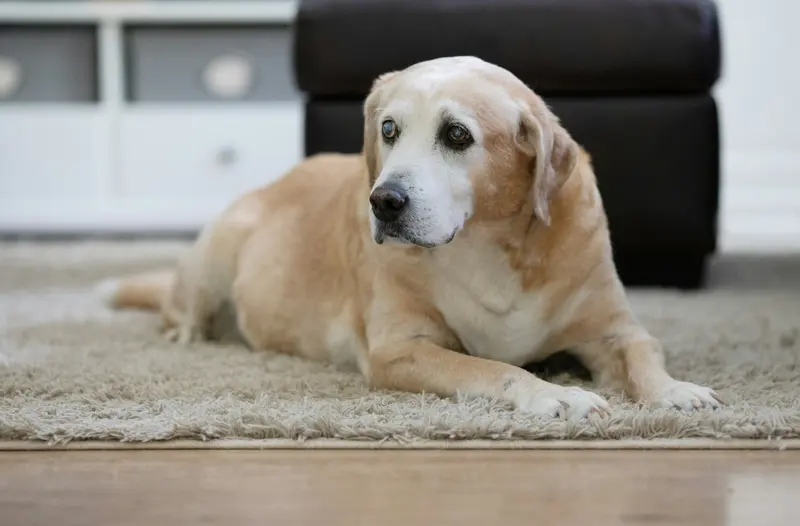
A young dog grips a smooth floor with its pads and catches a slide with fast, strong hind legs. Age erodes both. Muscle comes off the hindquarters first, arthritis makes the dog shorten its stride and hold its weight forward, and a stumble that a five-year-old would correct without thinking becomes a splay.
Two grooming changes make it worse without anyone noticing. Older dogs walk less on pavement, so their nails wear down less and grow long enough to reach the floor before the pads do; the dog ends up standing on hard nail tips on a hard floor. And the fur between the pads grows out over them, which works like a felt slipper. [Dr. Buzby's ToeGrips — tips to stop a dog slipping]
None of that is an emergency. It is worth a vet visit, though, if the slipping came on suddenly, affects one side more than the other, or comes with a dog scuffing its toes, standing on the tops of its paws, or wobbling when it walks. Those point to something a grip can't fix, and some of it is treatable.
The order to fix it in
1. Nails and paw fur
This costs nothing but time and does more than anything you can buy. Keep the nails short enough that they clear the floor when your dog stands, and trim the fur level with the pads. Many older dogs dislike clippers; a quiet grinder that takes the nail down a little at a time is easier on both of you.
If you'd rather grind than clip
Dremel PawControl 7760-PET
Cordless, with a 4-volt lithium-ion battery and USB charging, and a nail guard set at a 45-degree angle that also catches the dust. Grinding lets you shorten a long nail gradually, which matters with an older dog whose quick has grown out with the nail.
2. The floor: map the routes
You don't need to carpet the house. Watch where your dog actually walks for a day: bed to water bowl, sofa to back door, the turn into the kitchen. Those few paths are where the falls happen, and turning corners is harder than walking straight. Cover them with runners.
A good runner on hardwood still slides unless something holds it down. An open-grid rug pad underneath stops the runner skating when your dog pushes off, which is exactly the moment it matters.
Under the runners you already own
Gorilla Grip non-adhesive rug pad, 2×6 ft
Grips both the rug and the floor without adhesive, and the open grid lets the floor breathe. The 2×6 size sits under a standard hallway runner.
3. Traction on the dog
If your dog still splays after the first two steps, add grip to the paws themselves. There are three main approaches, and the right one depends mostly on what your dog will tolerate.
| Type | How it grips | Upkeep | Best for |
|---|---|---|---|
| Nail grips (ToeGrips)Our pick | Rubber sleeve on each nail tip, where nail meets floor | Replace every 1–3 months | Most senior dogs; nothing touches the pads |
| Grip socks (Walkee Paws) | Silicone dots on stretch socks held up over the back | On and off daily; washable | Dogs that won't tolerate anything on their nails |
| Adhesive paw pads | Textured stickers on the pads | Wear off; replace often | A quick, low-cost trial |
Our pick for most senior dogs
Dr. Buzby's ToeGrips
A small rubber sleeve slips over the tip of each nail and acts as a cleat exactly where the nail meets the floor. Because nothing covers the pads, most dogs ignore them in a way they rarely ignore socks or boots. They were developed by a veterinarian, and the maker says they typically last one to three months, two on average, before you replace them. [ToeGrips FAQ]
Sizing is by your dog's ideal weight: Large, for example, is for dogs of roughly 40 to 74 pounds. Trim the nails before you measure or fit them. They are less likely to stay on a young, very active dog, which is not usually the dog reading about this.
If your dog won't accept nail grips
Walkee Paws non-slip leggings
Ordinary grip socks twist and slide off. These attach over the dog's back with two adjusters, so they stay on, and the silicone dots sit under the paws. They're made from a four-way stretch fabric with vents for all-day wear, and they double as a barrier for a dog that licks its paws.
What slipping costs
The fall itself is rarely the worst of it. A dog that slips a few times learns to avoid the room: it stops coming into the kitchen, waits at the edge of the hall, or stays on its bed rather than cross the floor to you. Less walking means faster muscle loss, and faster muscle loss means more slipping. Fixing the floor early keeps your dog moving, and moving is what keeps an old dog strong.
When it's more than the floor
Traction helps a dog that can still hold itself up. If the back legs are giving way even on carpet, the dog needs support as well as grip: a rear-support harness lets you take some of the weight when it stands or climbs. For getting onto the sofa, the bed or into the car, see dog ramps for senior dogs and ramps for beds. For the wider sequence, start with our senior dog comfort guide.